


£95.00
£195.00

Joya are the only footwear to have been medically tested and proven to help improve back pain, knee and hip pain. They are also great for neuropathy, hallux rigidus and plantar fasciitis. They work by really cushioning your feet and correcting your posture to alleviate stress on your joints.
We have helped many of our customers with a variety of health issues with Joya as they really do help. Joya does offer width fittings which are generally slim to average width, although there are styles that can cater for a wider foot.


Joya


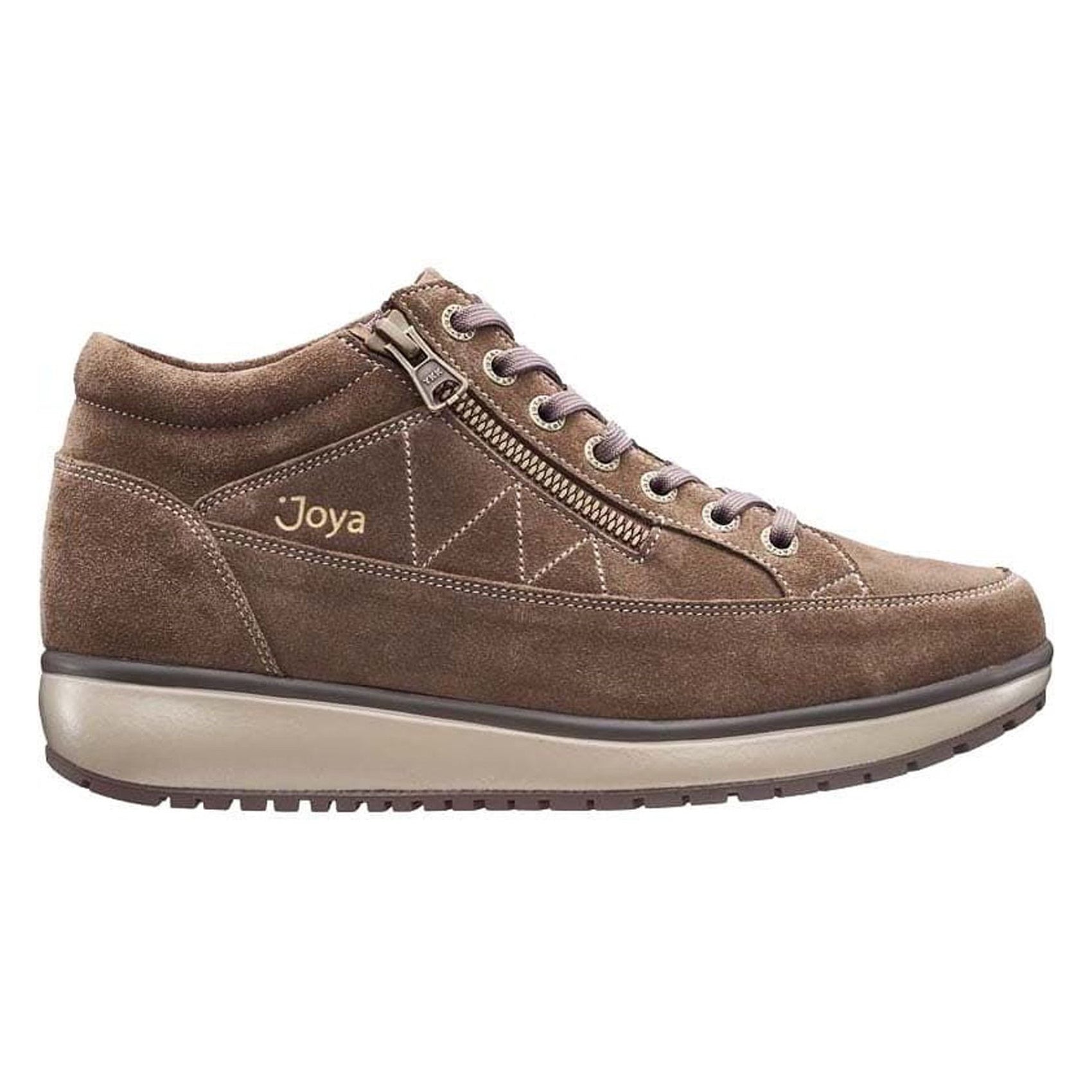


Joya


Joya shoes are designed so the load on the sole of your feet is distributed when standing or when walking, from the moment your heel strikes the ground to the point when the foot lifts off from the tips of your toes Rather than being concentrated on certain spots.
When your heel strikes the soft Joya sole, your foot makes “micro-movements” which can also activate the muscles around the joints in the feet, hips and back. The soft polyurethane soles provide effective cushioning, which can take the pressure off your backbone and lighten the load on your spinal discs.
Wearing Joya shoes also stimulates the blood flow in the legs and is also a good means of improving your sensorimotor system. That is a preventive advantage for people who develop neurovascular complications.
The word “sensorimotor” is made up of two parts and can be roughly defined as ideal interplay between sensory processes (in the nerves) and motor processes (in the muscles).
One key element of sensorimotor exercise is that it is carried out on a soft, moving surface.
Sensorimotor exercise in Joya shoes activates the small muscles around the joints more strongly, which can help take the load off your joints and spinal discs.
Renowned doctors, orthopaedists and gait specialists recommend Joya.
After years of development and testing, Joya have created their range of shoes.
All Joya soles have one thing in common: they turn the hard, flat ground into a soft, supple surface, giving wearers comfort, wellbeing and a very special feeling when walking.
MBT was launched on the market as a medical exercise device.
Joya is a comfort shoe whose soft sole from heel to toe additionally offers health benefits with a super-soft polyurethane material stretches over the whole sole, while in MBT shoes it is only found around the heel. This means that Joya shoes envelop your feet extremely softly.
In MBT shoes there is a hard plate which provides the “rocker effect” when you stand and guides your feet as you roll through a step.
Joya embrace the philosophy of allowing natural freedom of movement, keeping your feet in charge, meaning that the small muscles in the feet can be targeted more precisely and allowing a more natural roll-through movement than in MBT shoes.
Moreover, with Joya shoes you do not need any special gait training as with MBT.
Thanks to their soft soles, Joya shoes lighten the load on your heel, forefoot and midfoot, which can be helpful with various kinds of foot pain.
With conventional shoes, most of the pressure is on the heel and forefoot, coming to a peak in the big toe at heel-off. This can lead people to suffer potentially painful problems such as bunions (Hallux valgus) or, later, arthrosis of the main joint of the big toe (Hallux rigidus). As Joya changes the load distribution over the sole of the foot, it can help with all of these conditions.
Joya stimulates the muscles in your foot. Joya helps you to roll your foot through on the outer side and can thus help take the load off the overtaxed structure on the inward side of flat feet.
The soft sole adapts to fit the shape of your foot well. If you have extremely high arches, however, it is indeed advisable to use a soft additional insole.
Joya can help with plantar fasciitis, as the soft sole reduces the pressure on the curve in the foot where the plantar fascia is located. If the inflammation has already ossified (as a heel spur), Joya shoes' soft sole can have a positive effect on pressure, taking the load off the ailing structure.
Orthopaedic insoles can be worn in Joya shoes, though we do recommend wearing insoles that are as soft as possible or designed for sensorimotor exercise, to ensure that the Joya shoes can maintain their function. We also recommend wearing your Joya shoes without insoles at certain times to give your muscles the exercise they need.
Joya can help with metatarsalgia, as the soft sole lightens the load in the forefoot. Some Joya soles feature an additional, ultra-soft forefoot cushion to reduce the load in the case of pain of this kind.
In the case of tendon overuse injuries, a common occurrence when the Achilles tendon is overtaxed, relief mainly comes from stretching, putting weight on the tendon in a physiologically appropriate manner (pressing down hard on the outer heel without bending inwards) and keeping the blood flowing through the area. With their soft sole, Joya shoes perfectly cushion impacts on your joints and feet; they are
recommended by doctors and physiotherapists to patients recovering from pain in the Achilles tendon. Your feet may well need a certain amount of time to get used to the shoes.
Walking on a soft surface in Joya shoes forces your body to make tiny balancing movements, which means more work for the joint-stabilising muscles in
your hips. The soft Joya sole also cushions the impact on the hard, flat ground. All these factors can be of advantage, especially at the preoperative stage.
We recommend waiting 6–8 weeks after the operation before wearing Joya shoes, though they can be worn in the post-operative phase under the supervision of your doctor or therapist.
Heel lifts can be worn with Joya shoes when there is an actual difference in length of more than one centimetre (due to a congenital abnormality or a fracture of the thighbone or shinbone). If the difference is less than one centimetre it is not normally necessary to wear heel lifts.
At foot strike, your foot sinks into the soft Joya sole, causing the pelvis to be lowered on that side. This movement in turn means that the back muscles need to work more, which can have a positive effect on back
problems. The soft Joya sole also cushions the impact on the hard, flat ground, which can also be beneficial in the case of back problems.
In the case of acute slipped discs or shortly after an operation on your intervertebral discs, we only recommend Joya under the supervision of a doctor, as the additional movement in the pelvis can be counter-productive in such cases.
Once the problem has been dealt with, Joya shoes can be worn both during the post-operational stage and as a means of prevention
Joya shoes can be worn by patients with either insulin-dependent (Type 1) or non-insulindependent (Type 2) diabetes.
The Joya size range is made to suit its intended target group (EU sizes 35–49 / UK sizes 2–14).
Any age group can benefit from Joya technology.
